

Asus TUF Gaming VG279QM 280Hz Gaming Monitor Review
Nosotros continue our look into the latest generation of loftier-refresh IPS gaming monitors with a review of the Asus TUF Gaming VG279QM. Although the TUF family is generally associated with value offerings, there are a few unique and loftier-terminate features Asus is providing with the VG279QM.
The beginning is the ability to "overclock" this monitor from 240 Hz to 280 Hz, some other is ELMB-Sync, which allows you to use backlight strobing and adaptive sync at the same fourth dimension. Those two combined with Asus' promise of 1ms grayness to greyness response time, we're set for very high levels of performance.
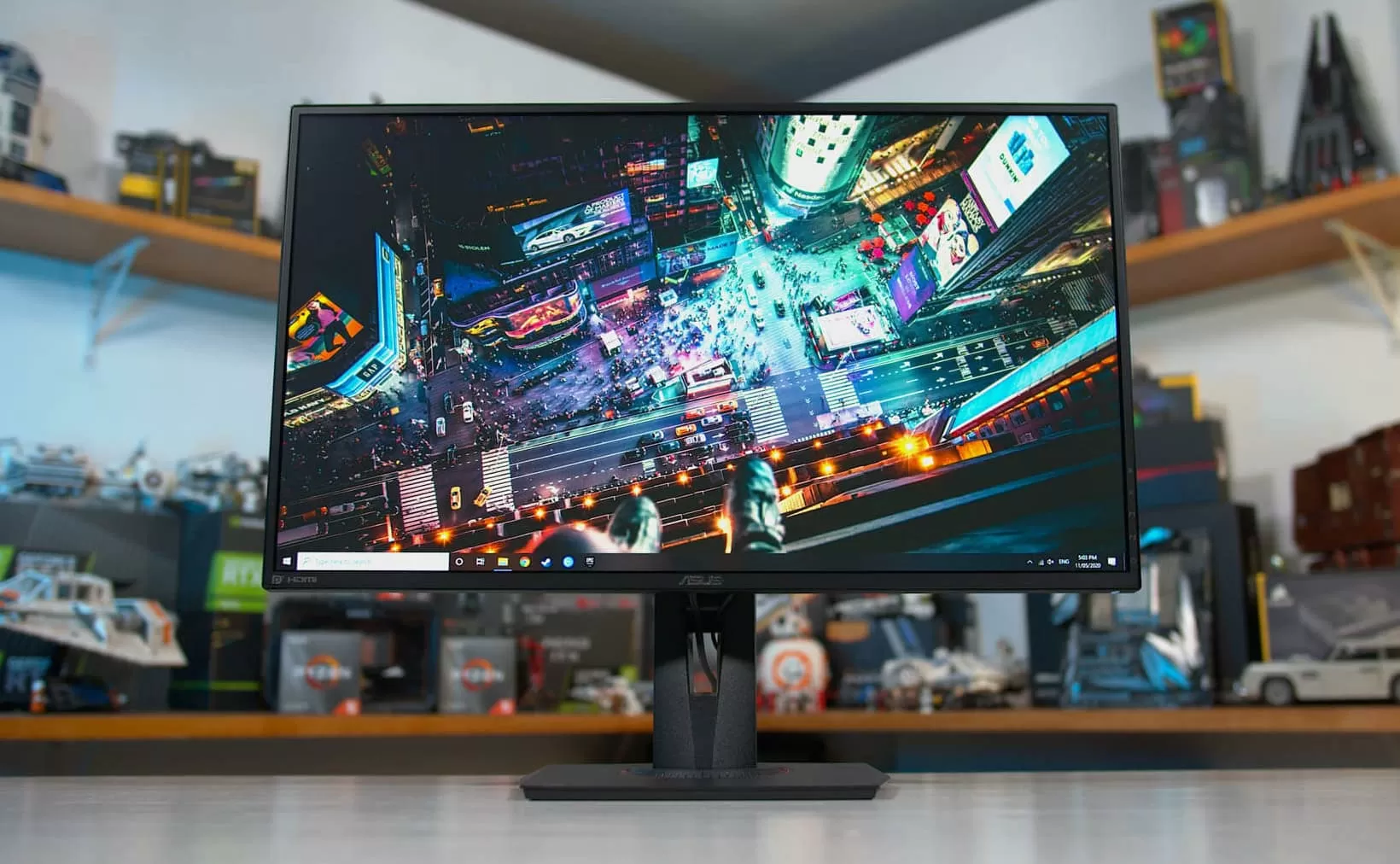
Having already been impressed with how other new 1080p 240Hz IPS displays take performed -- namely the MSI MAG251RX and the LG 27GN750 -- it'll exist interesting to see how this Asus alternative fares.
Asus claims this is the "world's fastest gaming monitor", which probably is correct if they are strictly referring to the refresh rate. On the other manus, they've also touted back up for HDR technology through DisplayHDR 400 certification, yet this isn't an HDR monitor in any sense of the word as it lacks virtually of the necessary hardware features.

The TUF Gaming VG279QM has a list price of $400, putting information technology in competition with the LG 27GN750 and making information technology a tad more expensive than the MSI MAG251RX, though that's a smaller display.
Speaking of size, we've mentioned earlier that we find 27-inches a little too large for a monitor that simply packs a 1920 x 1080 resolution. We feel the sweet spot or fifty-fifty maximum size for that resolution is 24-25 inches. The pixel density isn't bully, however Asus likewise offer a 24.5-inch alternative in the VG259QM -- all the same features including a 280Hz refresh rate and the same class of panel from AU Optronics. This doesn't mean the 27 and 24 inch monitors will perform the aforementioned, but it's worth pointing out in that location are two models in this line-upwards if you lot're interested.

The concrete blueprint of the monitor is similar to their other TUF Gaming displays, and it's 1 that we quite like. Information technology'due south not equally aggressive or over the peak as ROG products, it'south a fleck easier on the eyes, only still with enough gamer elements that you won't mistake this for an office monitor. Yet unlike ROG, the outer facing materials for this display are most all plastic, it doesn't wait bad but metal ofttimes gives a more than premium impact.

There's decent stand adjustability, including the full complement of height, tilt, swivel and pivot back up. We'd accept liked a bit more height bachelor, just it still ends up quite decent and has VESA mounting support should yous need it. It'south a sturdy feeling brandish stand, too, despite all the moving parts.
Asus offers a directional toggle for controlling the on screen display on the right side of the monitor, plus a few quick access buttons. Asus' software stack built into their screens is pinnacle notch and includes a broad array of gaming features, including crosshairs, timers, refresh charge per unit displays, shadow boosting modes, and even a "sniper" mode. It'southward easy to navigate, too, Asus conspicuously knows what they're doing.

For inputs you become 2 HDMI two.0 ports and DisplayPort ane.ii. The HDMI ports are express to 240Hz, then if you're interested in overclocking the monitor and running it at 280Hz, you'll need to be using DisplayPort. At that place are built in speakers, but they're barely serviceable.
Operation
Let's become into the earth-shaking response time testing, and in typical Asus mode they are offering half dozen overdrive modes labelled 0 through 100. Let'southward go through the basics and then focus on a few of these options because one-half of them really aren't worth talking near.
Response Times / Overdrive Modes
The 0 overdrive mode is overdrive disabled, not much going on hither, response fourth dimension average of 5.64ms is pretty adept for native panel performance. twenty is also quite mild on the overdrive forepart. The 40 mode is where things heat up a fiddling bit, we're now reaching a sub-5ms grey to grey boilerplate at 280Hz, although this isn't quite fast enough to get a true 280Hz experience. There is an incredibly tight 3.57ms refresh window requirement here, then only 50% of transitions get close to this in this style.
Asus TUF VG279QM - Overdrive Off (280 Hz)

Asus TUF VG279QM - Overdrive twenty (280 Hz)

Asus TUF VG279QM - Overdrive forty (280 Hz)

Asus TUF VG279QM - Overdrive 60 (280 Hz)

Asus TUF VG279QM - Overdrive fourscore (280 Hz)
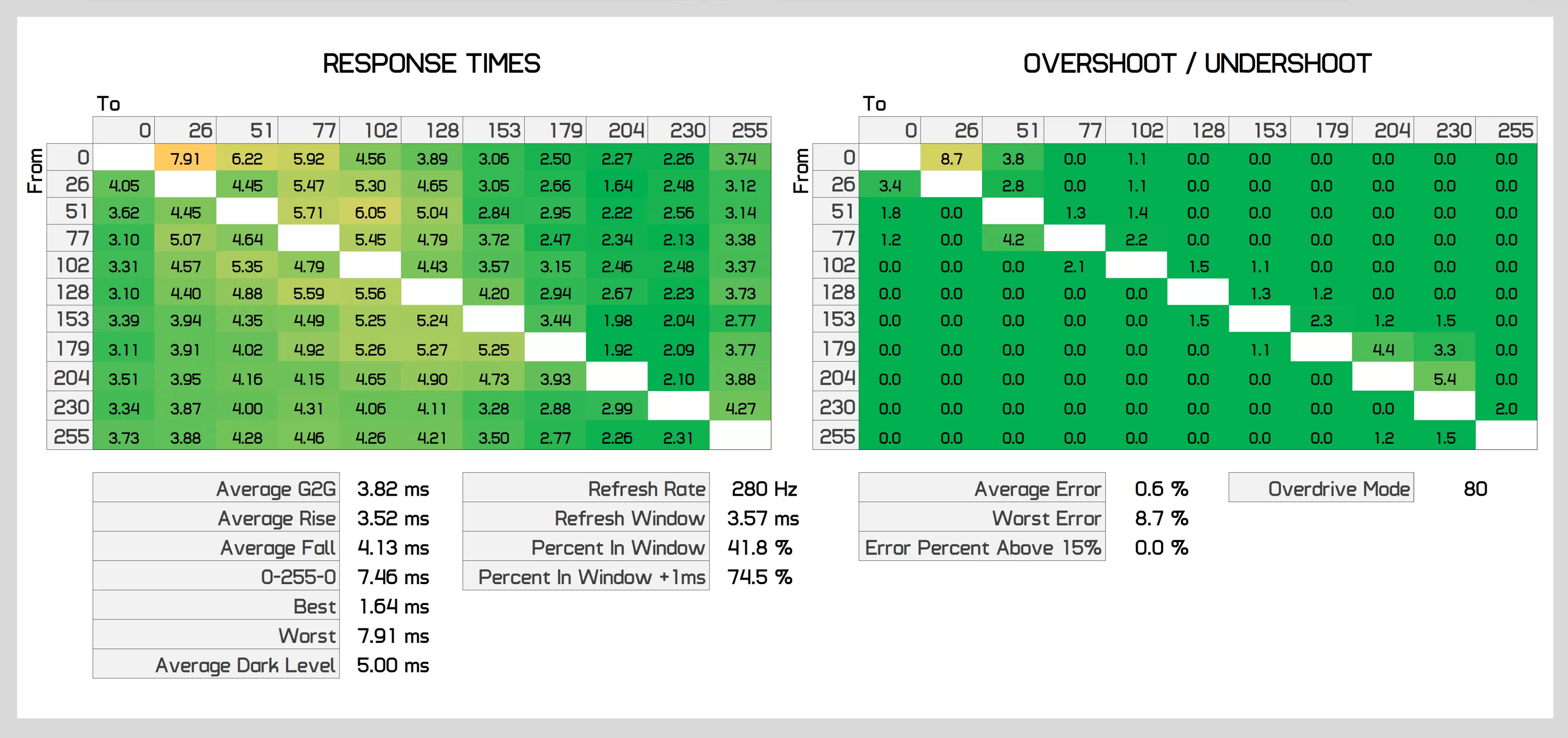
Asus TUF VG279QM - Overdrive 100 (280 Hz)

Stepping upward to overdrive 60 presents an interesting situation that I've never seen before with a monitor. This manner, despite being a college listed overdrive fashion, is actually slower on average than overdrive 40. Asus appears to change the way they implement overdrive for levels 40 and below compared to 60 and above, which creates a different experience. The difference isn't massive, but slower is slower.
Overdrive 80 is where you want to be sitting for gaming at the maximum refresh rate. Response times autumn to three.82ms on average, and in that location's no observable overshoot. Nosotros are only getting around 75% refresh rate compliance, so this is a borderline 280Hz experience, but in exercise information technology is a slight footstep upwardly from 240Hz. Then at overdrive 100 we see a typical state of affairs where to attain a 1ms greyness to gray response time in their marketing textile, they've blown out overshoot levels to the betoken where the mode is unusable.
Thus, overdrive 80 is the all-time for gaming at the maximum refresh charge per unit, simply it isn't every bit suitable for lower refresh rates. In my testing I establish the mode to be fine upward until 200 Hz or so, merely when dropping downward to 144Hz and below, we start to get meaning levels of overshoot. While response times are consistently between 3 and 4ms, at any refresh rate below 144Hz you lot'll easily spot inverse ghosting.
Asus TUF VG279QM - Overdrive 40 (144 Hz)

Asus TUF VG279QM - Overdrive twoscore (lx Hz)

For gaming across the adaptive sync range, we're then left with two options: OD 40 and OD 60. As mentioned a moment ago, OD threescore is actually slower on average, and this holds throughout the unabridged refresh range. While threescore delivers effectually a 5.2ms grey to grey average at most refresh rates, OD 40 is more around iv.6ms, so roughly ten-15% faster. And from the response time charts yous tin come across how the overdrive implementation seems to change betwixt the two options.
OD xl besides fairs a little better at lower refresh rates than OD threescore. At 85Hz for example, OD 60 produces an average mistake of v% with fifteen% of transitions producing noticeable inverse ghosting. With OD 40, the mistake average is slightly lower and we have just 8% of transitions with inverse ghosting. This is, again, despite OD twoscore beingness faster overall.
Asus TUF VG279QM - Overdrive 80 (200 Hz)

This leaves the VG279QM with 2 overdrive mode choices depending on how you are using the monitor. At loftier refresh rates, y'all'll want to use OD lxxx for the best clarity above 200 Hz. For lower refresh rates, at 144Hz or beneath, OD xl is the way to become, however this way isn't fast enough to deliver a "true" 280Hz experience at the top end. Ultimately there's no single overdrive style that's the best for the entire refresh range, I'd probably stick to 40 if you lot're simply occasionally going above 200 Hz just for esports titles similar Fortnite and Overwatch on a loftier performance PC, 80 is what you should use.

Let's compare the VG279QM to some other loftier refresh monitor options. This chart shows the maximum performance yous can get out of a monitor, and what's interesting is that despite the 27GN750 and VG279QM using different panels, both perform very similarly in terms of response times, both effectually that three.8ms mark. The Asus variant is a chip faster of class, being able to striking a 280Hz refresh rate instead of 240Hz.
The MSI MAG251RX uses the smaller 24.5-inch AU Optronics console and is a piffling more aggressive on the overdrive, assuasive information technology to perform slightly meliorate. The inherent differences between each of these three models is pretty modest though, and performance is largely dictated by how well tuned the overdrive controls are.
So we have TN options which in full general are a step higher up in terms of response time performance. These "0.5ms" class panels can typically offer 3ms response times throughout the entire refresh rate range without many overdrive concerns, and would be the go to option for those that care more almost functioning than any color qualities.

With refresh rate compliance, the VG279QM does suffer a trivial bit in striving for a 280Hz refresh charge per unit, which is why it sits a bit lower than other 240Hz IPS monitors in this nautical chart. While 280Hz is a borderline experience, 240Hz is easily achievable with over 90% refresh charge per unit compliance. In fact speaking of this divergence, is 280Hz even worth information technology?


Well for starters, a 280Hz panel is only 17% faster in terms of maximum refresh rate than a 240Hz console, which at these sorts of refresh rates is hard to distinguish betwixt. Here'southward some pursuit camera tests with Mistiness Busters' UFO image and on the VG279QM, the 280Hz image is slightly clearer but honestly the difference is pretty small and I don't recall 280Hz is worth much of a price premium over 240Hz.

We found no issues with input lag operating at 280Hz. This is a very responsive monitor with side by side to no input lag concerns. We did find the monitor was a fleck slower in terms of input lag at 60Hz and refresh rates below 100Hz, at least with fixed refreshes, not certain what'due south the crusade simply the 27GN750 didn't take that problem.

The other major selling point to the VG279QM is ELMB-Sync, which attempts to deliver backlight strobing with adaptive sync simultaneously. Having backlight strobing only at fixed refresh rates is a major limitation of the engineering in my eyes, and then I appreciate Asus trying to introduce to gear up this meaning downside of using strobing.
While the implementation is decent compared to similar IPS monitors, if there are bug with strobe crosstalk or double images, I don't think the way is worth using. The VG279QM does produce minor image repetition while using ELMB-Sync at a variety of refresh rates, and this can be distracting while gaming compared to merely the regular not-strobed way. However, these artifacts are less noticeable than on a monitor similar the MAG251RX, then it'due south far from the worst offender.
Personally I wouldn't use this style given it's intended to produce a crystal clear image while gaming and it kind of doesn't practise that, simply other people might exist less sensitive to these artefacts and it might depend on the game you're playing. The implementation needed a bit more work to achieve what information technology prepare out to attain.
Color Performance
Moving into color performance now and there's nothing specially unique about this IPS offering, given it'south just a standard sRGB display. This is identical to the other high-refresh 240Hz options I've tested, which also only offer an sRGB gamut. Nonetheless in the example of our review unit, Asus has done a cracking job of calibrating this monitor out of the box for greyscale performance.
Default Color Performance


The CCT bend is reasonably flat and the monitor follows the sRGB gamma curve to a adept degree. This leads to an impressive dEITP average of 2.94, or just 1.29 using the former dE2000 metric. This is an fantabulous upshot for a gaming display out of the box, with no appreciable color tint.
Saturation performance isn't quite as proficient, just it's non due to an unclamped gamut. Instead, there is a small amount of drift at higher saturation levels, seen in some of the blue and greenish results specifically. Zip overly bad, but a saturation deITP average of half-dozen.22 could be improved. However this isn't something that OSD controls can tackle. Similar story for ColorChecker, the overall deITP average is decent but zilch mind blowing.
Calibrated Color Operation


I wasn't able to amend functioning through OSD tweaks and so the next step is a total colour scale, which will hopefully accost some of the small color drift nosotros saw. And it does that quite nicely, while besides improving greyscale accuracy to a dEITP average below 2.0. Saturation is likewise below 2.0 at present, simply limited past the panel not quite being able to hitting 99% sRGB coverage. Then for ColorChecker we come across standard results from a calibrated IPS console, which is to say operation is very strong.

The VG279QM is capable of great brightness levels, around the 400 nit marker after calibration, which is in keeping with its DisplayHDR 400 certification. This should be suitable for most use cases. Then for contrast ratios, pretty standard stuff from an AU Optronics IPS, at effectually the 1000:ane mark. This is better than the 27GN750 which uses an LG Nano IPS panel, the ones known to take weaker contrast, simply not as adept equally the MAG251RX.

I was actually expecting the VG279QM to perform more than in line with the MSI monitor, and I accept seen some reviews showing dissimilarity around ten% college than what I was able to accomplish. So information technology seems my unit is on the lower side for what this panel tin can accomplish, but I'm even so satisfied with around that 1000:ane mark. If yous want higher dissimilarity, yous'll have to cede speed and go for a VA console instead.

Viewing angles are splendid, no complaints in that location, and uniformity was very good with my monitor likewise. Not quite every bit solid for dark greys, but for total white virtually the unabridged brandish is the same with only slight fall off along the left border with my unit. When you buy an IPS you lot await swell uniformity and that's what y'all go. As for IPS glow, zippo unusual with my unit of measurement to report.
As mentioned in the overview intro, the VG279QM comes DisplayHDR 400 certified, but realistically this monitor cannot provide an HDR feel. Without local dimming, the single-frame contrast ratio cannot get even close to high enough for the requirements of HDR, while effulgence isn't adept enough and there's no wide gamut support. This monitor fails all three requirements of HDR.
280Hz or Not?
Overall, this is another solid showing for high refresh rate IPS monitors. We've now tested three 1080p displays that hit or exceed 240Hz and all deliver bully functioning at that refresh rate. While TN panels continue to agree the operation crown, IPS is 18-carat competition and propective buyers accept a keen culling that doesn't sacrifice color quality.
The TUF Gaming VG279QM performs almost identically to the other 1080p 240Hz IPS displays we've tested, and so in that location'south no articulate winner from a response time perspective. No model nosotros've reviewed is perfect -- you'll demand to change overdrive modes depending on whether you lot're gaming at super high or moderate refresh rates -- but in general nosotros were impressed with the overall performance. These panels handle 240Hz really well, and in the instance of the Asus TUF, borderline capable of 280Hz.

While the upgrade from 240Hz to 280Hz is small in most instances, given functioning is otherwise the same between say, the VG279QM and LG'southward 27GN750, all of a sudden that slight bump to refresh rate becomes a selling point. Normally nosotros'd merely say the deviation is negligible and not to bother factoring information technology into your buying decision, but in this case we do feel the 280Hz refresh rate gives Asus an border in functioning.
What is less of a selling point is ELMB-Sync, which due to double epitome bug only has limited usability, although information technology is better than other implementations nosotros've seen on IPS monitors. LG doesn't include this feature at all on their brandish, so Asus does provide something actress if yous want to use it.

Everything else about this monitor is pretty adept. Fantastic manufactory greyscale calibration, nifty effulgence, better contrast than the 27GN750, a keen, functional design and plenty of OSD features. Advertising HDR when it'due south not HDR capable is a bummer, but non a huge deal.
Based on what we've seen and so far, this is the best high refresh IPS monitor on the marketplace. With a competitive $400 toll signal, it's not more expensive than like options, so it'southward the display we'd recommend.

If you're a tad concerned nearly pixel density, should the 24.v-inch variant deliver like operation, that could exist an fifty-fifty better choice when it hits the market. Asus has done a great chore with this monitor and they keep to offer awesome value in their TUF monitor range.
Shopping Shortcuts:
- Asus TUF Gaming VG279QM on Amazon
- LG 27GN750 on Amazon
- MSI MAG251RX on Amazon
- HP Omen Ten 27 on Amazon
- AMD Radeon RX 5700 XT on Amazon
- GeForce RTX 2070 Super on Amazon
- GeForce RTX 2060 Super on Amazon

Source: https://www.techspot.com/review/2029-asus-tuf-gaming-vg279qm/
Posted by: barberowerew.blogspot.com
0 Response to "Asus TUF Gaming VG279QM 280Hz Gaming Monitor Review"
Post a Comment